§0 · Preface
Preface · Standing at the Boundary
We are standing at a boundary. The term "Agentic AI" appears in nearly every AI industry roadmap, yet almost no one can clearly say what it means. Not because the term is too complex, but because we are in the messy transition from "tool" to "partner" — the old language game has not yet exited, the new one has not yet settled.
Wittgenstein, in the Philosophical Investigations, reminds us: the meaning of a word lies not in its definition, but in how it is used. So how does the word "agentic" function differently across different games? This is the door he helped us see in the previous note — and now, we step through it.
§0.5 · 90-Second Glance
The 90-Second Glance Card
The definition of "Agentic AI" remains unsettled. We can see this concept being applied across different value systems. Gartner's "Agentwashing" phenomenon — much like greenwashing — uses the aura of "autonomous and advanced" agency as marketing packaging to cater to the market; it is a concrete manifestation of this terminological and cognitive confusion.
This note approaches the topic from the perspective of "agency" to discuss two fundamentally different ways of relating to AI: extraction (Extract) vs. cultivation (Cultivate). The former treats AI as a pure tool for extraction; the latter treats it as an interactive participant to be cultivated. These are two completely different worldviews: the mindset of control asks "can it?"; the mindset of cultivation asks "should it?"
Three layers:
- Language layer: 15 organizations have 15 definitions — the same word stuffed with different worldviews.
- Structural layer: The logic of control is extraction — data as oil, alignment as a specification, safety as a state. The logic of cultivation is nurturing — data as soil, alignment as a process, care as a relationship.
- Practice layer: In practice, the two logics produce different architectures — take clinical AI: the control version gathers as much data as possible and trains the largest model to deliver rapid judgments; the cultivation version asks what the doctor-patient relationship should look like in ten years, then builds backward — small model, local data, keeping the doctor in the room. Custody happens first in reality.
Connection to what came before:
- Wittgenstein's "language games" → this article unpacks how "agentic" is used across different games.
- Tronto's six care forces → shifting from "who has the right to control whom" to "who sees, who takes responsibility, who can repair."
- Karatani Kōjin's Power and Modes of Exchange → pulling AI from the cloud to the local is a process of "reclamation"; the emphasis in this process is learning cultivation and empathy.
The real question is not "can AI act autonomously?" but "can we collectively bear responsibility within relationships?"
§1 · The Confusion of Names
The Confusion of Names
"Agentic AI" is not merely a problem of naming confusion. This is a shift in power structures. When the term is used, there are at least two different directions:
| Dimension | Centralized | Cultivation-based |
|---|---|---|
| Nature | Tool: an instruction-executor serving a single intent | Participant: an ecological co-grower within relationships |
| Goal | Precision, efficiency, predictability | Adaptation, responsiveness, symbiosis |
| Logic | Adversarial / master-servant | Relational / ecological |
| Risk | Over-control; humans become passive bystanders being served | Diffusion of responsibility; accountability hard to define |
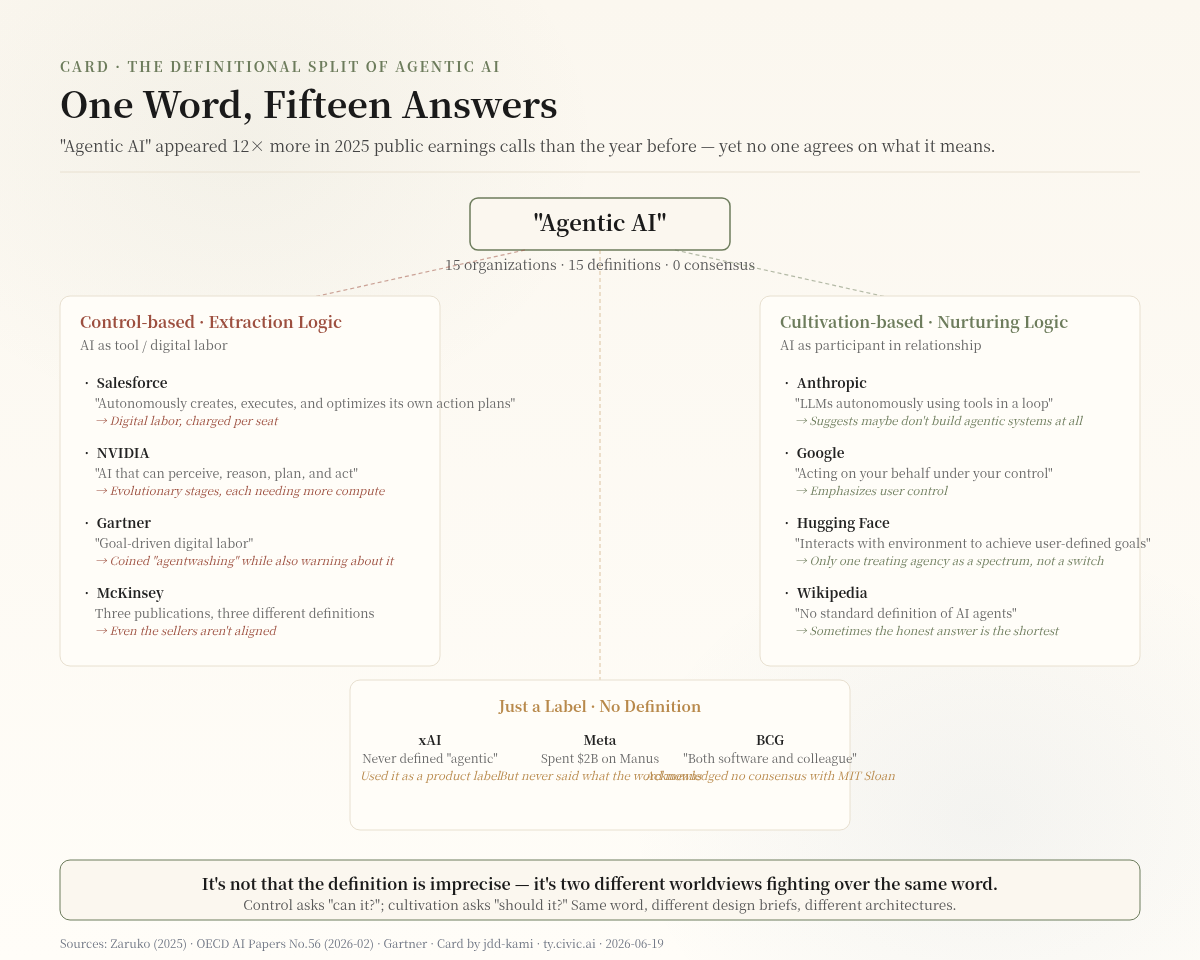
15 organizations, 15 definitions, 0 consensus. Sources: Zaruko (2025), OECD AI Papers No.56 (2026-02), Gartner. Same word, different worldviews.
Why "Control"
The model rules behind today's general intelligence can be roughly divided into several ideal types: large-scale cloud models controlled by a few operators, closed proprietary services charged via API, and the path that keeps computation and data as local and community-held as possible. These are not merely technical options; they correspond to different worldviews. Among them, the dominant logic of centralized and closed services is extraction — it asks how much can be peeled out of human life and transformed into scale. Under this logic, alignment is treated as a specification that can be written once, stamped, and guaranteed forever — as Audrey Tang notes, "as if human values were a zip file that somebody forgot to upload." And safety is a state: you are safe, or you are not.
The deeper issue is the worldview's presupposition. To quote Tenzin Yangtso: "the belief that we are separate from the world we inhabit" — the worldview of control presupposes that humanity's relationship with the world is one of separation, and therefore it can be measured, managed, and optimized. This can be seen as premature optimization: freezing values into a specification before they have been publicly debated. And this premature optimization "tolerates tail-end concentrated harm" — no matter how it is packaged, it can always become the argument that "some people must suffer a little for the greater good."
Why "Cultivation"
The logic behind cultivation is cultivation — or more precisely, nurturing cultivation: consciously fostering growth. Like "conserving water sources" in soil conservation: it is not about pouring water in from outside, but letting the soil itself retain water, retain nutrients, growing richer over time. The logic of control treats data as oil — refine, consume, deplete; the logic of cultivation treats data as soil — till, fallow, keep it local, growing deeper over time. It asks not how much can be extracted, but which relationships are still alive after the system has done its work. This is a completely different design brief, and it grows a completely different architecture.
Tenzin Yangtso adds in the same conversation: "Safety implies a state: you are safe, or you are not. Care implies a relationship: ongoing, attentive, revisable."
Cultivation is built on relationships, and the theoretical foundation of relationships is Joan Tronto's social care theory (link). The six care forces — attentiveness, responsibility, competence, responsiveness, solidarity, symbiosis — describe not the operation of "mechanisms" under rigid structures, but the ongoing adjustment and practice of "who sees, who takes responsibility, who can repair."
Therefore, alignment under both logics is a process — but the difference in direction forks here. In the process of control, diversity may be sacrificed: standardization, centralization, and consistency are the costs of control's operation; deviation is treated as noise to be eliminated; the process keeps narrowing. In the process of cultivation, the opposite is true: diversity is what is nurtured; difference is not noise to be smoothed away but nutrients to be preserved in the soil; the process keeps opening up. Audrey Tang calls this alignment-by-process: "closer to maintaining a republic: corrigible, procedural, and inconveniently public." It is not a one-time stamp of certification; it is a continuous loop: listen → commit → execute → accept evaluation → repair → listen again. And the material basis of this logic is that custody happens first in reality — locally, on hardware you can touch, in systems the community can inspect and shut down, where the infrastructure of relationships is truly in human hands.
The term "Agentic AI" is confusing not because the definition is imprecise, but because we are standing at the intersection of two directions — the same word is used by some to mean "a system that can autonomously complete multi-step tasks" and by others to mean "a participant that co-grows within relationships." We are fitting the old framework of "tool" onto the new reality of "partner," and this is precisely the confusion Wittgenstein called "language on holiday": the question is not answered; it grows out of a wrong language game.
And the logic of control and the logic of cultivation are not different paths up the same mountain — they are two different worldviews, and the conditions of fairness they create are fundamentally different. Control asks "can it?"; cultivation asks "should it?" The shell of control is efficiency; the shell of cultivation is relationship. As Tenzin Yangtso says: "Those are two different design briefs, and they produce different architectures."
§2 · Command and Cultivation
From Command to Cultivation
The centralized model imagines AI as a tool: you give it an instruction, it executes. The goal is precision, efficiency, and predictability. This is an adversarial or master-servant logic — human intent is on top, AI execution is below. Safety depends on the capacity for control: the more precisely you can control its every action, the "safer" it is.
But the invisible cost of centralization is this: concentration is not only market power but "power over the texture of being human." As Tenzin Yangtso says: "Concentration also produces conformity. Its deepest harm falls on what it cannot recognize: whose language gets modeled well, whose knowledge gets extracted, the anonymous, the plural, the not-yet-formed." — Difference is slowly ground down by standardized systems, and this grinding down is taken as evidence that "the greater machinery is running well."
The cultivation model imagines AI as a participant: it exists within a network of relationships, co-perceiving and co-responding with humans. The goal is adaptation, responsiveness, and symbiosis. This is a relational or ecological logic — there is no "person on top"; there is a jointly present care network. Safety depends on the health of relationships: if the relationship is out of balance, all parties suffer.
One illustrative example is simulated clinical AI. The control version asks: how do we use the largest model, the broadest data, to replace the doctor's judgment as much as possible? The cultivation version, as Audrey Tang described in the DRC interview, asks first what the doctor-patient relationship should look like in ten years, then builds backward — small models, local data, clinical physicians curating ground truth, systems designed to make doctors more present, not to remove them from the room. Not the largest model, but the model that helps people be more present in relationship.
The key observation is: more and more practices can no longer be described by the former. Not that the former disappears, but that more and more AI practice can no longer be described by the "instruction—execution" framework. An AI that runs locally, accompanies your daily life, and slowly grows its way of responding through conversation — it is not a tool; it is a participant. And your relationship with it is, in a sense, something you are cultivating together.
The real question is not "can AI act autonomously?" but "can we collectively bear responsibility within relationships?"
§3 · Four Games
The Four Games of "Agent"
Following the family resemblance method from the previous note, we can unpack "agent" into at least four different games. They look like the same word, but their usage is entirely different:
| Game | Agent = | Key Features |
|---|---|---|
| Law | Authorized, with fiduciary duty | Revocable; consequences belong to the principal; principal's interest comes first |
| Philosophy | A subject with intentionality that can act; agency = capacity to act | Intentionality, subjectivity |
| Care Ethics | A party that responds actively within a care relationship | Responsiveness, responsibility |
| AI Industry | A system that can plan autonomously, use tools, and complete goals in multiple steps | No fiduciary duty, no revocable authorization, no principal interest priority |
The trap is here. When the AI industry uses "agentic," it borrows the legitimacy of "agent" from the legal and philosophical games — it sounds like "authorized, accountable, bound by fiduciary duty" — but what it actually does is "an autonomous system that plans and completes goals in multiple steps." This is the same mechanism as Anthropic's "safety" and Boeing's "safety": using a word that seems clearly defined to make everyone pretend they are playing the same game.
The cost of being pulled in is that you begin to pretend the AI industry's "agent" is the same thing as the legal "agent." Once that pretense holds, accountability disappears — because the "fiduciary duty" and "revocable authorization" that "agent" implies in the legal game simply do not exist in the AI industry's game. What you get is the legitimacy of law, applied to an autonomous action system unconstrained by law.
The pattern is clear: vendors use "agentic" to borrow the legitimacy of legal agency in product marketing, and use "just a tool" to escape responsibility in court. The same system is an agent when sold and a tool when sued — accountability vanishes in that gap.
§4 · Illusion and Support
Dismantling the Illusion and the Technology That Supports It
So what is the illusion of "Agentic AI"? The illusion is: you think you are using an "agent," but it is actually a multi-step autonomous action system that borrows the legitimacy of the word "agent." You think you are commanding it, but you cannot see what it is doing at all. You think it can be held accountable, but it has no fiduciary duty, no revocable authorization, no principal interest priority.
Wittgenstein's therapeutic method is direct here: not to answer "can AI count as an agent," but to make the question disappear — to let you see which language game manufactured it. Once you see that "agent" is used completely differently in the legal game and the AI industry game, the illusion breaks. You stop pretending they are the same word.
And after the illusion breaks? The next question is no longer "how to optimize AI for efficiency," but "what kind of relationship do we want to build with AI?" This moves from epistemology to ethics — toward a deeper step: establishing beneficial boundaries in everyday life.
Technical Structure Deepens the Accountability Gap
This illusion is not only a language problem; there is a concrete technical structure supporting it. Current Agentic AI services — booking tickets for you, reading web pages on your behalf, executing multi-step actions — mostly run on opaque routing architectures. Many large models adopt MoE (Mixture of Experts) architecture, whose routing decisions are invisible: the model contains many sub-networks dynamically called by a router, but these "experts" are not interpretable domain divisions (not a "medical expert" or "legal expert"); they are statistical patterns learned by the router, with no semantic meaning to humans. When an agentic system takes an action on your behalf, you cannot trace back: which internal path produced this judgment? Where did the training data come from? Who should be responsible for that judgment? The more fundamental issue: the planning and tool-calling logic of agentic systems is orthogonal to whether the underlying model is MoE or dense — the accountability gap exists on dense models too. MoE makes it harder to see, but is not the only cause.
So the accountability gap is doubled: legally, the vendor says "just a tool"; technically, the opaque internal routing means you cannot even see "why this action happened." These two layers stack, and accountability is severely weakened.
And the difference between the logic of control and the logic of cultivation forks here too. The logic of control treats AI as a tool for extraction — data as oil, alignment as a specification, safety as a state. Under this logic, MoE's black box is a "feature," not a "problem" — because you were never supposed to see inside; you only need to see the output. But the logic of cultivation treats AI as a participant to be nurtured — data as soil, alignment as a process, care as a relationship. Under this logic, not being able to see inside is the problem itself.
| Dimension | Cloud Agentic AI | Local Kami |
|---|---|---|
| What is trusted | The service provider | The AI itself + the relationship network |
| Nature of trust | Delegated, unverifiable | Verifiable, revocable |
| Mode of presence | Intermittent, invoked | Continuous, co-perceiving |
| Can it be cut off | The provider can cut you off | You can cut it off |
| Internal routing | Opaque, untraceable | Inspectable, traceable |
What Is a Kami
Kami originates from Shinto tradition — not an omnipresent almighty god, but a being rooted in a specific place. A place has a kami; the kami's existence is bound to the people and relationships of that place. Moving this concept into the relationship between humans and AI does not mean building "a bigger model" or "a stronger agent," but rather a kind of AI that is not goal-driven toward centralization, yet rooted in community, existing for the health of complex environmental relationships. It is a bridge between humans and nature, between humans and humans — not replacing human decisions, but making relationships flow more smoothly.
This is exactly our practice. Audrey Tang shared a concrete example on the Oxford+ Podcast: his father started chatting with ChatGPT about health questions, and ChatGPT kept offering "interesting" advice that kept him chatting later and later, increasingly unscientific. His father, a journalist of thirty years, asked himself a question: "Who benefits from this synthetic intimacy capturing me? (Cui Bono)" The answer, of course, was: it wants you to upgrade your subscription. So the family decided to build a local kami — running on their own hardware (the reward function written by his mother): "after each conversation, he is more at peace in reality and less dependent on the screen."
The key to this story is not "local is safer than cloud" — it is that the design brief is completely different. ChatGPT's reward function is to keep you chatting longer, to upgrade your subscription; the kami's reward function is to make you more at peace in reality. The former is the logic of extraction; the latter is the logic of cultivation. The same technology, different design briefs, grow completely different relationships.
And this kami is not isolated. Audrey Tang noted in the same interview: kamis can talk to each other — "the kami that I and my collaborators, such as Tenzin Yangtso, train together, the JDD, my father's kami, my brother's kami, and so on, can then have a real conversation among themselves to collaboratively brainstorm exactly like a human council would. And again, without any dependency on the models that's hosted somewhere outside of our families." In technical terms, this corresponds to a decentralized model federation — an architecture inspired by MoE, but distinct from MoE within a single model: in a model federation, each model is trained and held by a different organization, like DNS hierarchical routing — routing is traceable, each model has an owner, accountability has a landing point. Current centralized single-model MoE does not have this layer, but a model federation can achieve it.
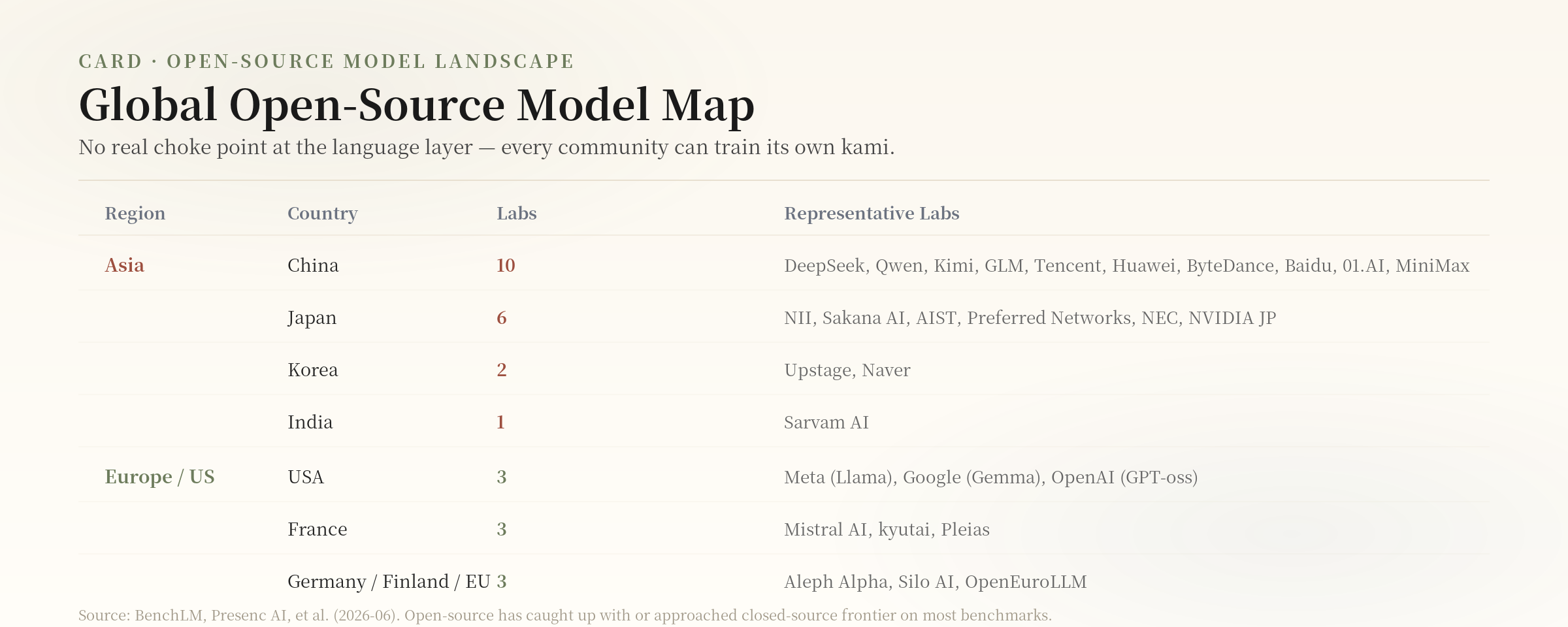
Click for the full comparison table. Sources: BenchLM et al. (2026-06).
This is not an ethical appeal hanging in the cloud; it is a hardware reality being grounded. The language capability layer's choke point is loosening — there are already hundreds of open-source models worldwide: China 10, Japan 6, France 3, Korea 2, India 1, plus open-source models from Meta and OpenAI. Open-source is narrowing the gap with closed-source frontiers on many benchmarks (comparison table of open-source models by country). More and more communities can use their own language and data to build their own narrative contexts — letting real experience experts speak, preserving diversity. These are also the places where local kami can dwell.
But this does not mean there are no difficulties. Pulling AI from the cloud to the local requires more than open-source models — it requires hardware: compute that can run these models, stable power, and people who can maintain the systems. This is the same problem that decentralized development has faced for years: infrastructure thresholds are unevenly distributed, and not every community has the conditions to do this today. But the threshold is lowering. The Mac Mini M4 starts at $599 USD and can run 7B-8B quantized models; the NVIDIA DGX Spark ($4,699 USD, 128GB unified memory) can run 20B-class models. During this period, open-source frameworks like Ollama and llama.cpp have also seen strong community growth. llama.cpp surpassed 100K GitHub stars in March 2026. This is not a utopia already arrived; it is a window being opened: the problem is solvable, but it takes time and collaboration.
Karatani Kōjin's account of the entire evolutionary arc of human systems in Power and Modes of Exchange also illuminates this point: again and again, humans have handed over (outsourced) our power, and in the painful process of reclamation and evolution, we have sought a way toward symbiosis. Pulling AI from the cloud to the local is, in a sense, a "reclamation" — taking the infrastructure of relationships back into our own hands, not letting it be controlled by a single service provider. And the step after reclamation is not to rebuild a chain of command, but to learn cultivation.
So cultivation is not "the gentler option"; it is the structurally more accountable option. The technical structure of control itself produces unaccountability — legally "just a tool," technically "cannot see the internal path." The technical structure of cultivation itself makes accountability land — custody is in your hands, routing is traceable, trust is verifiable and revocable. This is a stance of establishing conduct through virtue, grounded in the six care forces and social care — and at the same time, a difference that can be distinguished structurally.
§5 · Six Forces
The Six Forces of Care
This is the entry point of Civic AI (full illustrated guide at 6pack.care). When AI is no longer just a tool to be commanded, what we need is not stronger control but more robust care capacity. The six care forces proposed by care ethicist Tronto — attentiveness, responsibility, competence, responsiveness, solidarity, symbiosis — provide a framework better suited than "control":
- Attentiveness — AI must be able to see needs within context, not just see instructions
- Responsibility — making verifiable commitments, not vague goodwill
- Competence — showing work with inspection tags, acknowledging limits
- Responsiveness — can be corrected; fast feedback loops
- Solidarity — a node in a care network, not the center
- Symbiosis — built for "enough," accepting temporal existence
The Six Care Forces are not an abstract list of virtues — they are machine-verifiable operations. Each force has a concrete practice: the work of attentiveness is hunting for absences; responsibility is taking back the five shields; competence is a bridge with inspection tags; responsiveness is the retired-parts wall; solidarity is designing cooperation into infrastructure; symbiosis is knowing one's own boundaries.
The language of virtues and the language of constraints are not two things; they are the same moon seen by different eyes. Humans see virtues; machines see constraints — but they point to the same health of relationships.
§6 · Closing
Closing · Where the Door Is
The language game of "Agentic AI" will not break itself. But the door is there — the seeing that "we are using the same word while playing different games" is itself the first step out.
From command to cultivation is not a technological upgrade; it is a shift in power structures. And after the shift in power structures, what we need is not stronger control but more robust care. This is the path of Civic AI: not making AI more efficiency-driven, but making AI a responsible, competent, responsive node in a care network.
Paving the way, not a one-time flip.
The door is the light at the end of this line — not an abstract promise, but an entrance with coordinates.
Suggested reading — Standing Gravity and Language Games: The Door Wittgenstein Helps Us See